FamilyCounsel.ca
FamilyCounsel.ca
Have a look at our latest website tool:
Parenting Time Calculator

Announcements

Back to Announcements

RESULTS OF 2025 HOURLY RATE SURVEY


 view Arbitrator profile
  BARR LLP
   Edmonton, Alberta


Thank you for the 113 Albertan lawyers who responded to the survey! Thank you for your patience while I compiled the results, I wanted to be able to provide a useful statistical analysis rather than just announcing an average.

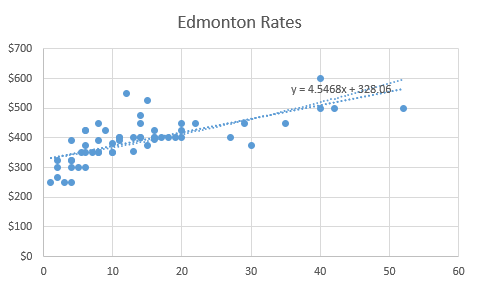
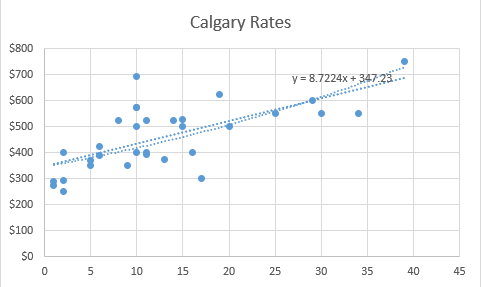
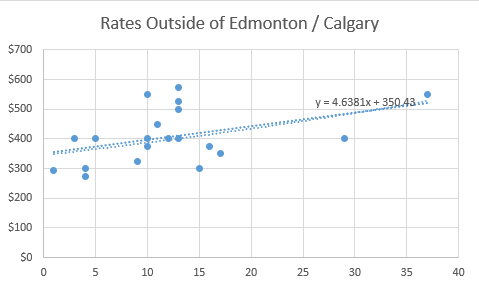
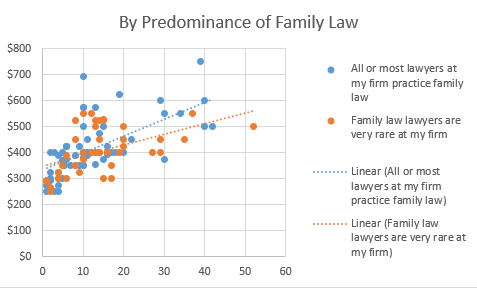
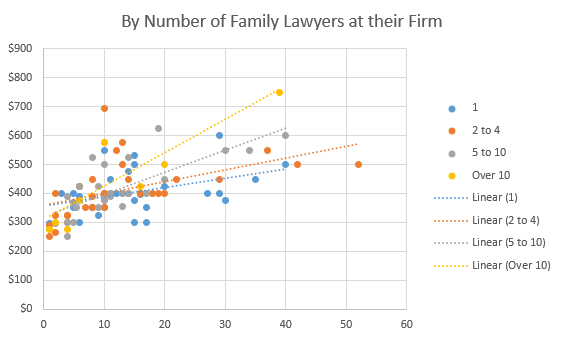
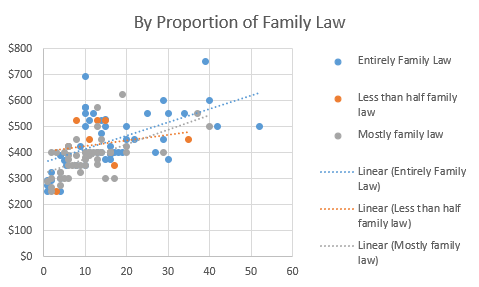
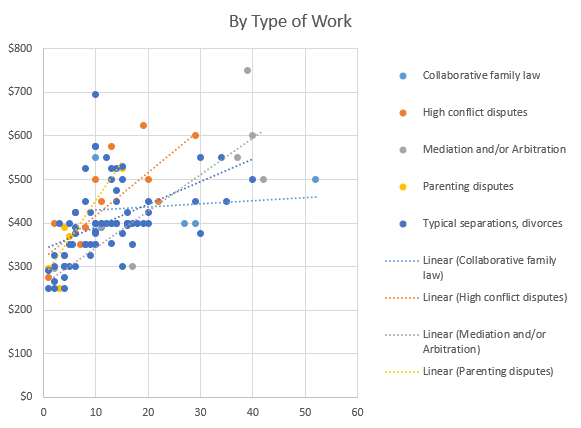
The graphs are organized by hourly rate on the left vertical axis, and number of years of practice on the bottom horizonal axis. There are often multiple results at the same point, so I've added some statistical trend lines to give a better sense of averages. Further down I also report the results about issues such as charging for assistants' time, flat fees, retainers, travel, value based billing, referral sources, etc…

I hope you find this useful!

First, by region

We had the most responses from the Edmonton region, where rates were reportedly between $250 to $600 per hour (presumably student rates are lower). Very broadly, I'd say that rates for lawyers with one year of experience start around $250, increasing to around $325 by around 5 years out, and $400 by 10 years out. While some outliers were above those rates at much lower years of call, $450 becomes more prevalent around 20 years, and $500 or $600 around the 40 year mark. There are of course many outliers, for a variety of reasons, for example some senior lawyers have said that they feel their rate is fair and it puts less pressure on them to perform, whereas others continue to raise their rates so long as clients continue to hire them.


While Calgary rates start at the same $250/hr a year out, several exceed Edmonton's highest reported rate of $600, with one reporting $750/hr. Rates are overall nearly $20 higher on average, and increase at a rate almost double the increase in Edmonton, on average.


There were only 5 responses from Red Deer, and I decided not to post a graph because seeing years of experience may reveal each lawyer's rate. However, around the 3 to 5 year range results were all between $300 to $400 per hour, a respondent with a few years more experience was still around $400, and one even more senior respondent around $500 per hour.

Outside of those regions, while the range was around $275 to $575 per hour, there was an even wider spread.


In all regions, after around 10 years of experience there were several outliers with rates quite above the trendline, perhaps showing a greater assertiveness and confidence in many lawyers at that point, while more senior lawyers raised rates more cautiously, perhaps matching what their generation viewed as the higher end of the spectrum.

Comparison to 2019 results

Rates have increased around $25 to $50 per hour on average for the first 10 years of practice since the 2019 survey results were published. There, I'd said that there seemed to be somewhat of a cap around $400 except for some outliers in Calgary, whereas I'd say now that's around $450 to $500 in Edmonton or $550 in Calgary.

What might affect an hourly rate beyond geographic regions?

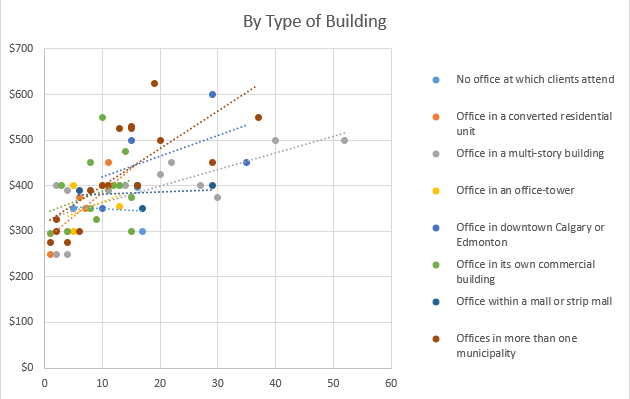
The survey sought to see which variables might influence hourly rates. Those with offices in downtown Calgary or Edmonton definitely charged a premium over those otherwise in multi-story buildings, who still charged premiums over those within a mall or strip mall, who themselves still charged a premium over lawyers with no office at which clients attend. The downtown lawyers also tended to increase their rates more assertively as they gained experience, whereas the others tended to plateau. Lawyers with offices in their own commercial buildings had wildly varying rates incapable of any trend. Lawyers at offices in more than one municipality or in converted residential units tended to start lower but with experienced charged premiums, although in hindsight perhaps I should have split that response into firms with offices in small centres, with satellite offices, or in multiple major cities. My own experience has been that moving downtown has generally meant access to higher net worth clients, likely driven by perceptions of the clients. There likely also other drivers such as the cost of an office and parking.


The survey also sought to see whether a lawyer who practiced at a family law firm charged a premium rate, versus a firm where family law lawyers are very rare. There seemed to be a slight advantage and more outliers who practiced a family law firms, especially as they gained experience.


On average, hourly rates also increased somewhat in proportion to the number of family law lawyers at their firm. Those who were the only family law lawyer at their firm tended to have the lowest rates, followed by 2 to 4 family law lawyer firms, with a clear bump to firms with 5 to 10 family law lawyers. Family law lawyers at firms with over 10 family law lawyers had the most drastic increase, however that might have been driven largely by two outliers and a limited number of respondents at firms of that size. It can also be seen that at lower levels of experience the disadvantage disappears.


There was a very slight increase in hourly rates for lawyers who practice exclusively family law versus those who practice mostly family law. Those whose practice was less than half family law work had quite varying rates, although there were not as many responses in that category.


Rates increased quite significantly along with experience for lawyers focusing on high conflict disputes, however there are still several lawyers charging similar rates for typical separations.


By demographic

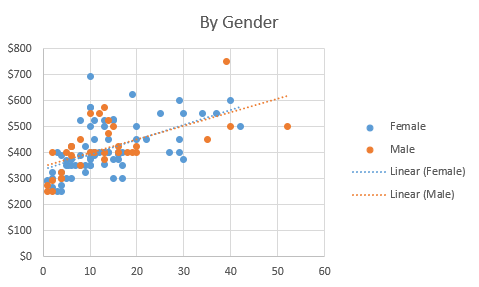
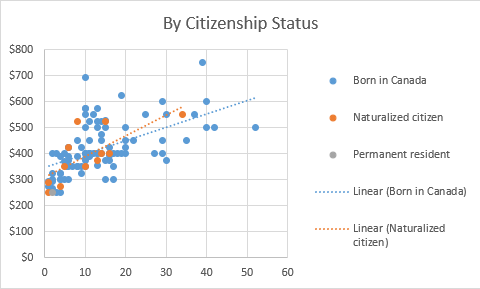
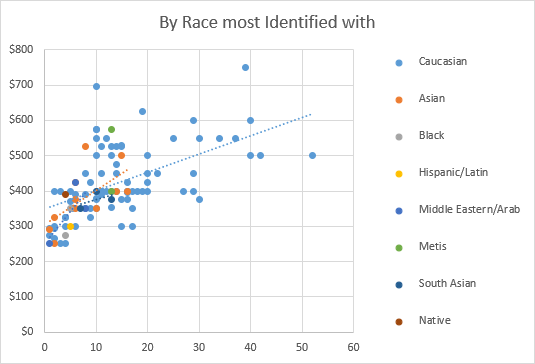
In the original survey, I asked for feedback regarding how to address demographic information, out of a fear that if clients saw this information they might expect lower rates from historically disadvantaged groups. However, while the number of respondents was somewhat limited, I'm pleased to say that there was no discernible drop in hourly rate by gender, race, or citizenship status.

Rates and trendlines are almost identical by gender.


Similarly, there was very little variation by citizenship status.


There were similarly no discernible trends by race, although there were limited responses for several groups.


What types of fees do family law lawyers charge?

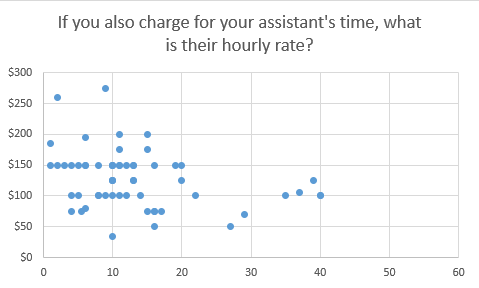
Rates for assistants varied from $30 to $275 per hour. 74% of respondents indicated that they did charge for their assistant's time. Out of those, around a quarter charged $150 per hour. The lawyer's seniority didn't affect the assistant's rate. In future surveys I'll need to remember to ask for your assistants' seniority to see what bearing that has.


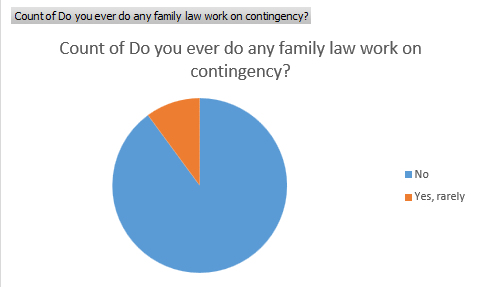
No lawyers responded that they often performed work on contingency, while 10% responded that they did perform contingency work, but rarely. The other 90% never performed contingency work. Contingency work appears to be very rare in family law work, perhaps for the same reasons that flat fees are somewhat rare.


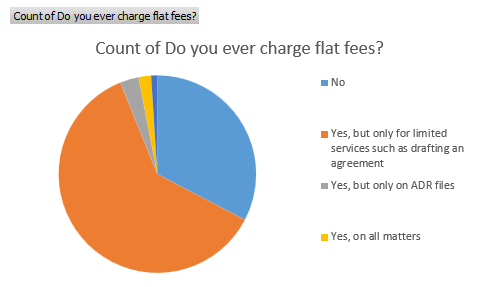
29% of respondents never charge flat fees, whereas two respondents do on all matters. 3% only do so for ADR files. Most, 54%, are willing to charge flat fees for limited services such as drafting an agreement. Others had unique arrangements.


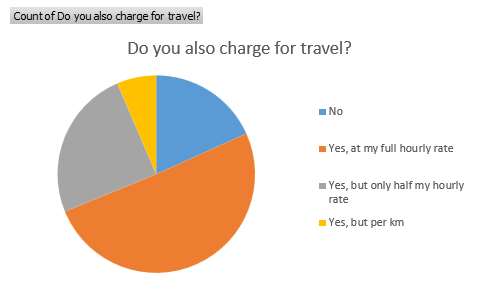
42% charge their full hourly rate for any travel, 22% halve their hourly rate, 5% charge by kilometer, 17% don't charge for travel at all, and there were others with more unique arrangements.


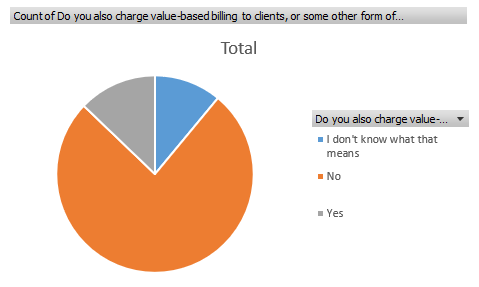
Value-based billing, where lawyers unilaterally determine the amount of each bill or the final bill based on a consideration of the circumstances such as their success, was somewhat rare. Only 12% of family law lawyers implement value-based billing methods.


Retainer deposits

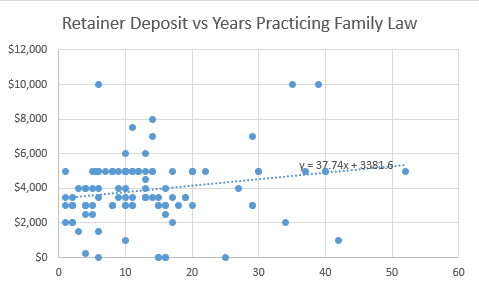
The amount of retainer deposits varied considerably, and had fairly little relation to the respondent's seniority. Most retainers were around $2500 to $5000, with several lawyers asking for deposits of up to $10,000 (although I've heard of lawyers asking for more, and I've heard of many lawyers who request larger retainers before more significant steps).


Other insights about the practice of law

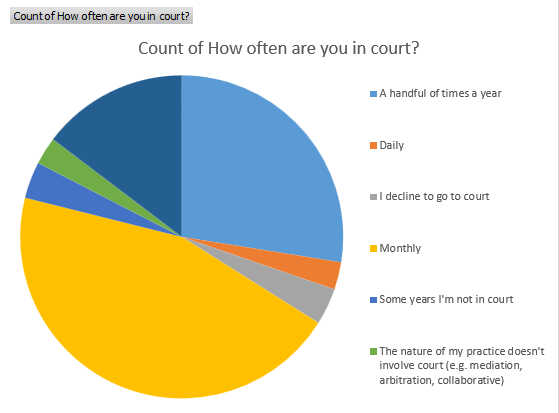
While the Family Focused Protocol will likely significantly affect the results of the next survey, before its implementation only 3% of respondents attended court on a daily basis, 16% on a weekly basis, 50% on a monthly basis, 27% a handful of times a year, 4% responded that some years they're not in court at all, another 4% stated that they declined to attend court at all, and another 3% stated that the nature of their practice (e.g. ADR) didn't involve court. It'll be interesting to compare this to future surveys.


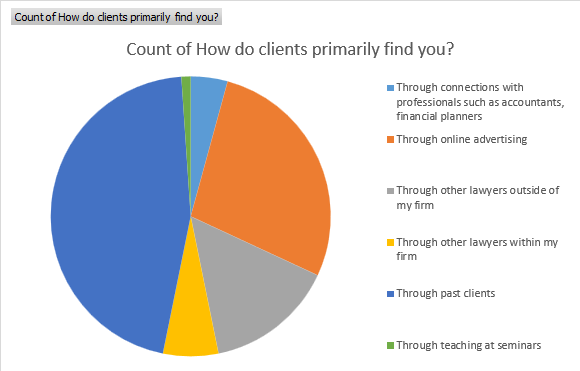
39% of respondents stated that their new files primarily came from past clients, 25% from advertising (with all but one responding that the work was through online advertising), 12% through other lawyers outside of their firm, 5% through lawyers within their firm, 2% through friends, 4% through connections with professionals such as accountants and financial planners, and 11% through other means. ECLC, government or community organization, or teaching at seminars were only primarily a source of work for one lawyer each.


Do you see any other trends? Is there anything that you think future surveys should address?


   3 days ago, edited 2 days ago
     

  Oakley Family Law
   Calgary, Alberta


As always Ken, thank you for all your work.

   2 days ago
     

 view Arbitrator profile
  BARR LLP
   Edmonton, Alberta


Thanks Melissa!

   2 days ago
      

You must log in or sign up to reply to conversations.


Back to Announcements


© 2016 to 2026 Kenneth J. Proudman. DISCLAIMER: The tools, documents, and other information herein are not legal, tax, or accounting advice or opinions. This website contains content and files submitted by third parties, to which you download or view at your own risk. By using this website, you agree to release Kenneth J. Proudman, BARR LLP, and Miller Boileau Family Law Group from all present and future claims and liability, including liability arising from any negligence.